GDELT vs a Google News API: which one fits your media monitoring?

GDELT and a Google News API answer different questions: GDELT tells you what the world’s media is covering, coded into events, themes and tone across 65 languages, while a Google News results API tells you which headlines rank for a search, and in what order. GDELT is free; results APIs charge per query.
Short answer: For research on coverage volume, tone or events across countries and languages, use GDELT: the DOC 2.0 API for the last three months, BigQuery for anything older. For brand alerts, share of voice in Google News or an AI agent that needs today’s headlines, use a Google News results API: Serpent API (from $0.01 per 1,000, pay as you go, no subscription; see pricing), Serper or SerpApi. If you need both, use GDELT to spot a spike and a results API to see which stories rank in a given country.
Are GDELT and a Google News API even the same kind of thing?
No, and most comparisons miss this. GDELT is an open research database. It watches news coverage worldwide, machine-translates much of it, and turns it into structured records: events, the people and places mentioned, themes and emotional tone. You query that database.
A Google News results API is a search tool. You send a query, a country and a time window, and you get back a ranked list of news results for that search, with position, source and time, and often a snippet. You query rankings, not a database.
That difference decides almost everything else. GDELT is strong where you want to count, chart and compare coverage across countries and languages. A results API is strong where you care about visibility: which story ranks first, which outlet leads a search in Germany, whether your brand appears today.
One more point of confusion: Google itself does not sell a news search API today, and the address of its old News Search API now lands on the general Google for Developers home page. The “Google News APIs” on the market are third-party APIs that return Google News search results. Our roundup of Google News APIs compares those providers one by one; this page is about the GDELT decision.
What does GDELT actually give you?
GDELT gives you free, open access to a very large, continuously updated record of global news coverage, in three main forms. Everything below comes from GDELT’s own pages, read on 20 November 2026.
The datasets
The GDELT 2.0 Event database and Global Knowledge Graph (GKG) update every 15 minutes. The Event database codes who did what to whom, and a Mentions table records every article that mentions an event, with its publication time. The GKG adds the people, organisations, places and themes in each article, plus emotion measures: GDELT’s 2015 launch post describes 24 measurement packages covering more than 2,300 emotions and themes.
Coverage is wide. GDELT says it monitors news “in print, broadcast, and web formats” in over 100 languages, and its Translingual system machine-translates coverage in 65 languages into English, which its launch post puts at 98.4% of its non-English daily volume. Its older GDELT 1.0 event files start on 1 January 1979.
The DOC 2.0 API
The DOC 2.0 API, launched on 20 June 2017, is the part most developers start with. It searches a rolling window of the last 3 months of coverage across all 65 translated languages, so you can type English keywords and match articles written in Spanish or Hindi.
It has many output modes. ArtList returns matching articles; TimelineVol, TimelineTone, TimelineLang and TimelineSourceCountry return coverage over time; ToneChart shows the spread of tone. Results come as HTML, CSV, JSON, JSONP, RSS or JSONFeed. An article list returns 75 records by default and at most 250.
Its query language goes beyond keywords. Operators include sourcecountry, sourcelang, domain, theme, tone and near, which matches words within a set distance of each other. TIMESPAN narrows the window down to a 15-minute minimum.
What the article list does not give you is the article text. GDELT describes its RSS output as “the list of matching article URLs and titles”, and the article list shows title, source country, language, date and a sharing image. If you need the text, you fetch each URL yourself.
BigQuery
GDELT says all of its datasets are in Google BigQuery, with the live tables updated every 15 minutes, and queryable in standard SQL. That is how you reach past the DOC API’s three-month window. BigQuery bills on-demand queries at $6.25 per TiB scanned, with the first 1 TiB each month free, according to Google’s pricing page. Wide GKG queries over long periods can scan a lot of data, so select only the columns and dates you need.
The terms, and the pace
GDELT’s terms allow “unlimited and unrestricted use for any academic, commercial, or governmental use of any kind without fee”, as long as you cite the GDELT Project and link to its site. That is unusually generous for data of this scale.
The DOC API does ask you to go slowly. On 20 November 2026 I sent two article-list requests to it, 25 seconds apart, from one machine. Both came back with HTTP 429 and the message “Please limit requests to one every 5 seconds”, followed by a suggestion that high-traffic users switch to GDELT’s Web NGrams dataset.
One request every 5 seconds is at most 17,280 a day, or about 518,400 in a 30-day month. Plan around that, and expect a shared server to answer slowly at busy times: each of those two responses took over 20 seconds.
What does a Google News results API give you?
A results API gives you ranked news results for your query, for the country and language you choose. Positions are what brand monitoring and PR teams report on, so this is the view that matters for them.
Take Serpent’s News Search API as a concrete example. You send q and optionally a country, a language, a freshness window from one hour (1h) to one year (1y), and an engine: Google, Bing, Yahoo, DuckDuckGo or Brave. You get up to 50 articles, or up to 5 pages with pages. Each article carries its position, title, URL, source and published time, plus a snippet and image where available; Google rows also carry google_news_url, the Google News link for the article.
curl "https://apiserpent.com/api/news?q=artificial+intelligence&num=20&country=us" \
  -H "X-API-Key: sk_live_your_api_key"
The documented response looks like this, cut to one article:
{
  "success": true,
  "query": "artificial intelligence",
  "type": "news",
  "engine": "google",
  "country": "us",
  "results": {
    "articles": [
      {
        "position": 1,
        "title": "AI Breakthroughs Reshape Industry",
        "url": "https://example.com/ai-news",
        "google_news_url": "https://news.example.com/articles/...",
        "source": "Tech News Daily",
        "publishedTime": "2026-03-02",
        "snippet": "Major advances in AI...",
        "image": "https://example.com/ai-news-thumb.jpg"
      }
    ],
    "totalResults": 20
  }
}
The output is deliberately plain: clean titles, sources, times, snippets and links that drop straight into an alert, a dashboard or an agent prompt. If you also want sentiment, run your own model over the titles and snippets. For a general introduction to this category, see news APIs for developers.
How do GDELT and a Google News API compare side by side?
The short version: GDELT wins on breadth, history, structure and price; a results API wins on ranked positions, per-country results, simplicity and pace. The figure and table below set it out.
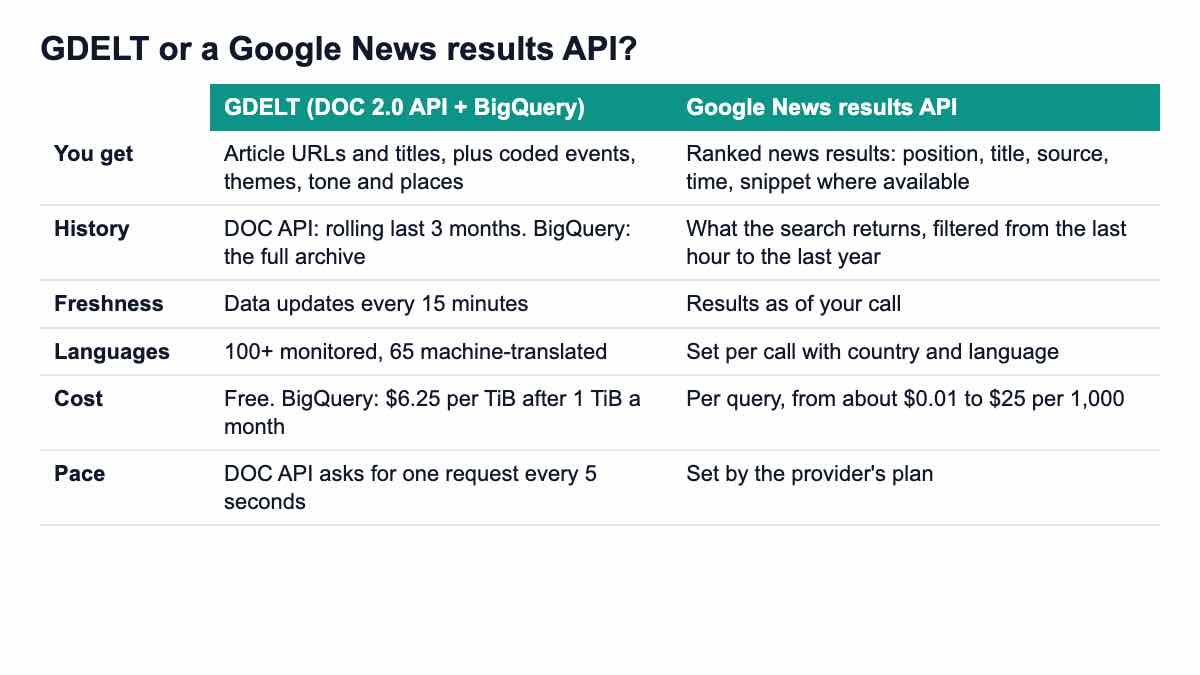
| Question | GDELT | Google News results API |
|---|---|---|
| What is a record? | An article (URL, title, language, country, date) or a coded event, theme or tone measure | A ranked headline: position, title, source, time, URL, and a snippet where available |
| How far back? | DOC API: last 3 months. BigQuery: GDELT 2.0 tables plus 1.0 events back to 1979 | What the search returns for the freshness window you pick (one hour to one year) |
| How fresh? | Data updates every 15 minutes | Results as of your call |
| Languages | 100+ monitored; 65 machine-translated, so English keywords match foreign-language articles | The country and language you set on each call |
| Ranking | No search ranking; articles match a query | Ranked positions per query, the thing PR teams report on |
| Article text | No; URLs and titles | No; title, and a snippet where available |
| Price | Free; BigQuery $6.25 per TiB after the first free TiB a month | Per query; about $0.01 to $25 per 1,000 at the volumes priced below |
| Pace | DOC API: one request every 5 seconds | Set by the provider’s plan |
| Support | Open project, no published SLA | Commercial support from the vendor |
Which is better for media monitoring?
It depends on which monitoring question you are answering, so here are the common ones with a pick for each.
“Tell me the moment we are in the news”
Use a results API. Run your brand name with a one-hour or one-day freshness window every hour, store each article by URL, and alert on new ones. It answers in seconds and costs fractions of a cent per check.
GDELT can do this too, but its pace guidance makes an hourly sweep over many brands slow, and a tight window often returns articles that rank nowhere in news search. Our PR monitoring guide walks through the full workflow.
“Where do we rank in Google News against competitors?”
Use a results API. Share of voice in Google News is a ranking question: who holds positions one to ten for your category terms, in each country. Only a results API returns positions. GDELT does not track search results pages.
“How is coverage of this topic changing across countries?”
Use GDELT. TimelineVol and TimelineSourceCountry chart how much coverage a topic gets and from where, and TimelineTone shows how the tone moves. Doing this with a results API means one call per country and language, and you would still have to build the tone measure yourself.
“Was coverage negative before the share price fell?”
Use GDELT, through BigQuery for anything older than three months. Historical tone and event studies are exactly what GDELT was built for. A results API shows rankings as of each call, so its history is the checks you have stored over time.
“Give my AI agent today’s headlines on a topic”
Use a results API. An agent needs a fast, simple JSON call with clean titles, sources and links, often many times a minute. One GDELT request every 5 seconds is a tight budget for an agent, and coded events are more than it needs.
“Monitor a crisis in a region where English coverage is thin”
Use GDELT first. Translation across 65 languages means one English query can surface local-language reports early. Then use a results API in that country and language to see which of those stories rank in local news search.
What does each cost at 1K, 100K and 1M queries a month?
GDELT is free at every volume; the cost is engineering time, the pace limit and, for history, BigQuery. Results APIs charge per query. I took each vendor’s live pricing page on 20 November 2026 and priced the cheapest published plan that covers each volume.
Rules used: a monthly plan is divided by the queries you actually use; a prepaid pack is priced by what you can use before it expires; overage is added where the plan publishes it; a free tier that bans production use is skipped.
| Provider | At 1,000 a month | At 100,000 a month | At 1,000,000 a month | Billing rule |
|---|---|---|---|---|
| GDELT DOC 2.0 API | $0 | $0 | $0, but above the ~518,400 a month that one request every 5 seconds allows | Free; pace guidance |
| GDELT on BigQuery | Per TiB scanned | Per TiB scanned | Per TiB scanned | $6.25 per TiB after 1 TiB free a month |
| NewsAPI.org | $449.00 (Business) | $4.49 (Business) | $1.75 (Advanced) | $449 for 250,000; $1,749 for 2,000,000; free tier is development only |
| SerpApi | $25.00 (Starter) | $7.25 (Searcher) | $3.75 (Cloud 1M) | Monthly plan; successful searches count |
| Serper | $8.33 ($50 pack) | $0.75 ($375 pack) | $0.50 ($1,250 pack) | Credits valid 6 months; credits per news query unverified |
| NewsData.io | $199.99 (Basic) | $13.00 (Corporate) | $1.30 (Corporate) | Monthly credits; one credit returns up to 50 articles on paid plans |
| GDELT Cloud | Unverified | Unverified | Unverified | $59 to $899 a month in Query Units; units per query not published on the page I read |
| Serpent API (News) | Default $0.20 · Growth $0.02 · Scale $0.01 · Enterprise $0.01 · Enterprise Plus $0.01, at every volume | Per query; tier set by deposit size, deposited credit does not expire | ||
Two notes on the arithmetic. Serper’s smallest pack is $50 for 50,000 credits that last 6 months, so at 1,000 queries a month you use only 6,000 of them, which works out to $8.33 per 1,000. At 1 million a month NewsAPI.org’s Business plan plus overage ($449 plus 750,000 extra requests at $0.0018) would be $1,799, so the $1,749 Advanced plan is cheaper.
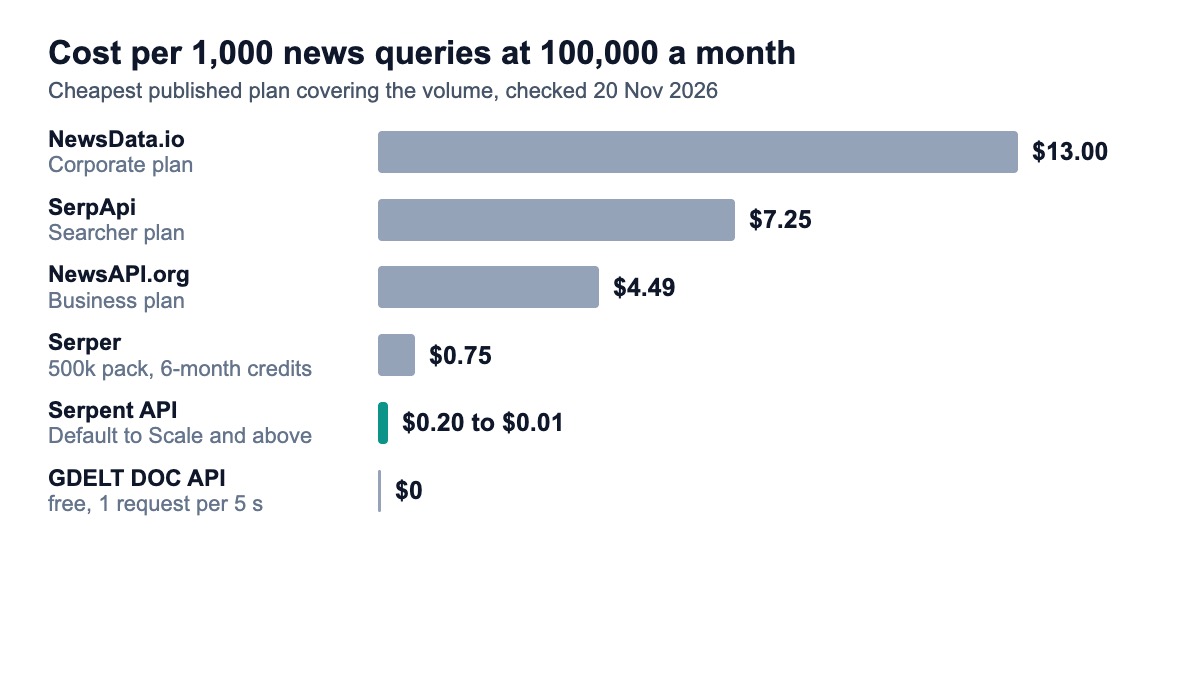
The figures also show why “GDELT is free” is only half the story. At 100,000 queries a month, the DOC API fits within its pace if you spread the calls evenly. At a million a month it does not, and you would be on BigQuery, where cost depends on how much data each query scans rather than how many queries you run.
For a free option to prototype with, our free news API guide lists what each provider gives away; Serpent API starts every account with 10 free API calls.
Can you use GDELT and a Google News API together?
Yes, and for serious monitoring it is often the best setup. Let each do the job it is good at.
- Watch volume with GDELT. Poll
TimelineVolfor your brand and category terms every few minutes, inside the pace guidance. A sudden rise, especially from a new source country or language, is your early signal. - Check visibility with a results API. When the timeline jumps, run the same terms through a news results API for the countries you care about, with a one-hour window. Now you know whether the story is ranking in news search, and which outlets lead it.
- Store by URL. Both sources give you article URLs, so the URL is your join key. Strip tracking parameters before comparing. Our guide to news story deduplication covers grouping several outlets’ versions of one story.
- Alert on the overlap. A story that is both rising in GDELT and ranking in Google News in your key market deserves a human; one that is only in GDELT can wait for the morning report.
This keeps the paid part small. You only run results-API queries when something is happening, and GDELT costs nothing while you wait.
What trips people up with each?
With GDELT
- The three-month wall. The DOC API cannot see past its rolling window. Teams build a dashboard, then discover they cannot backfill last year without moving to BigQuery.
- Machine translation. Matching English keywords against 65 translated languages is powerful, but brand names and product terms do not always translate cleanly. Test your terms in a few languages before trusting the counts.
- Coded events are noisy. Event coding is automatic. Treat individual event records as leads to read, and trust aggregates over single rows.
- The pace. One request every 5 seconds, and slow answers at busy times. Queue your requests and cache the results.
- No text. You get URLs and titles. Fetching and storing article text is a separate job with its own copyright questions.
With a Google News results API
- Rankings move. A position is a snapshot. Store the time of every check, and compare like with like: same query, same country, same window.
- Two URLs per article. With Google results each article carries
url, the publisher link when one is available, andgoogle_news_url, the Google News link. Useurlas your key, and keepgoogle_news_urlfor click-through. - “Fresh” is a filter, not a guarantee. A one-day window returns what the search treats as recent; a story can be re-dated or updated. Our post on news freshness explains how to check whether a story is actually new.
- Engines differ. Google, Bing and the rest rank news differently. Pick one engine per report so trends are comparable, and add a second engine only to widen coverage.
Which one should you pick?
- Pick GDELT if you are a researcher, analyst or data journalist measuring coverage, tone or events across countries and languages; you need history; you have the engineering time to work with large tables; and you can live with one request every 5 seconds.
- Pick a Google News results API if you are a PR, comms or SEO team that cares where stories rank; you need brand alerts within the hour; you report share of voice by country; or you are feeding headlines to an AI agent. Serpent API’s News API covers this from $0.01 per 1,000, pay as you go, no subscription (pricing).
- Pick both if you run monitoring for several brands or markets: GDELT for early volume signals at no cost, a results API to confirm visibility when something moves.
If you are still choosing between paid results APIs, start with the Google News API comparison, which compares those providers on price, freshness and coverage. If you are moving off NewsAPI.org, the NewsAPI.org alternatives guide matches each reason for leaving to a replacement.
How we checked this
On 20 November 2026 I read GDELT’s own documentation (the DOC 2.0 launch post, the GDELT 2.0 launch post, the data page and the terms), Google’s BigQuery pricing page, and the live pricing pages of NewsAPI.org, SerpApi, Serper, NewsData.io and GDELT Cloud, the address of Google’s old News Search API, plus four pages that ranked in a web search for “gdelt vs news api alternative” (a fifth returned a 404): 15 external sources in all. I sent two requests to the GDELT DOC 2.0 API; both returned HTTP 429 with GDELT’s pace message, and the log is kept with this article’s evidence. No calls were made to any paid API. Serpent API details come from our public documentation and pricing page, read the same day.
What I could not verify: how many Serper credits a news query uses (priced here as one); how many GDELT Cloud Query Units a request uses; and GDELT’s exact daily article volume, which one competitor puts at about 400,000 without a source.
Track where news stories rank
Ranked news results from Google, Bing, Yahoo, DuckDuckGo and Brave, as JSON from $0.01 per 1,000 — pay as you go, no subscription. Start with 10 free API calls.
Get Your Free API KeyExplore: News API · Playground · Docs · Pricing
FAQ
Is GDELT free for commercial use?
Yes. GDELT’s terms of use allow “unlimited and unrestricted use for any academic, commercial, or governmental use of any kind without fee”, and you may redistribute and republish the datasets. The one condition is attribution: any use or redistribution must cite the GDELT Project and link to its website. Your own costs are separate: BigQuery charges for the data your queries scan beyond the first free terabyte each month, and you pay for any servers you use to process the data.
What is the GDELT DOC API rate limit?
GDELT’s DOC 2.0 API asks for no more than one request every 5 seconds. When I sent two requests 25 seconds apart on 20 November 2026, both returned HTTP 429 with the message “Please limit requests to one every 5 seconds” and a pointer to its Web NGrams dataset for high-traffic users. At that pace you can make at most 17,280 requests a day. For heavier work, GDELT points users to its bulk datasets and BigQuery.
How far back does the GDELT API go?
The DOC 2.0 API searches a rolling window of the last three months of coverage, and its date parameters must fall inside that window. For older data, use GDELT’s datasets in BigQuery or its raw files: the GDELT 2.0 Event and GKG tables run continuously, and the older GDELT 1.0 event files start on 1 January 1979. A Google News results API, by contrast, returns ranked results for a freshness window of up to one year.
Does GDELT return the full text of articles?
No. GDELT’s article list returns URLs, titles, source country, language, date and a sharing image, and its RSS output is described as “the list of matching article URLs and titles”. The Knowledge Graph adds themes, people, places and tone extracted from each article, but not the text itself. If you need full text, you fetch each URL and extract it, which brings its own copyright and storage questions.
Is there an official Google News API?
Not today. Google’s old News Search API is no longer offered, and its developer address now lands on the general Google for Developers home page. The APIs sold as “Google News API” are third-party services that return Google News search results as JSON, with title, source, time and position, often with a snippet. They are the right tool when you care about rankings in a given country.
What is the best GDELT alternative for news monitoring?
It depends on what you used GDELT for. For brand alerts and share of voice, a Google News results API is the closer fit, because it returns ranked headlines per country. For a commercial news database with source, language and date filters, NewsAPI.org and NewsData.io sell plans from about $200 to $1,750 a month. For a commercial layer on GDELT data itself, GDELT Cloud sells plans from $59 a month.
Sources
GDELT and Google documentation (checked 20 November 2026):
- GDELT: DOC 2.0 API debuts (20 Jun 2017)
- GDELT 2.0: our global world in realtime (19 Feb 2015)
- GDELT data page
- GDELT about and terms of use
- Google BigQuery pricing
- Google News Search API address (now the Google for Developers home page)
Vendor pricing pages (checked 20 November 2026):
Pages reviewed for the gap check (20 November 2026):