Cheapest Google Trends API in 2026

On public prices checked on 20 November 2026, Serpent API has the lowest standing price of any Google Trends API I could find: $0.022 per 1,000 requests on its highest tier, about six times below the next lowest published rate ($0.136 at Scrapingdog), and $0.50 pay as you go, half Scrapingdog’s $1.00, the lowest entry price I could verify at monthly list prices. No subscription. Most API providers start at $1.00 per 1,000 or more, and every rate in this post is sourced and dated 20 November 2026.
Short answer: Up to a few thousand requests a month, use Serpent's pay-as-you-go rate of $0.50 per 1,000; the deposit tiers pay off only once you spend the deposit. At 100,000 to 1,000,000 a month, the higher tiers take a million requests from $500 down to $22. For a one-off research job, an Apify marketplace actor can look cheaper per result, but what one result means differs from actor to actor. If you need related queries, regional maps or a Trending Now feed, price SerpApi, HasData, Scrapingdog or DataForSEO instead of chasing the lowest row. And if you can get into Google's own invite-only alpha, it is worth a look.
If you are pricing a Google Trends API, the number on the pricing page is rarely the number on your invoice. One vendor counts a Trends request as five credits, another as ten. Some sell a monthly plan, others pay-per-task, and a marketplace of small scripts prices by the “result”, a word that can mean a whole report or a single row.
So I took every public price I could verify on 20 November 2026, converted it to dollars per 1,000 requests, and worked it out at three monthly volumes. Every rate links to the page it came from. Where a vendor does not publish enough to do the sum, the cell says “unverified” rather than a guess. One thing to keep in mind throughout: Trends numbers are a relative 0 to 100 index, not search volumes, so you are buying a shape over time rather than a count. The pytrends post explains that in more detail.
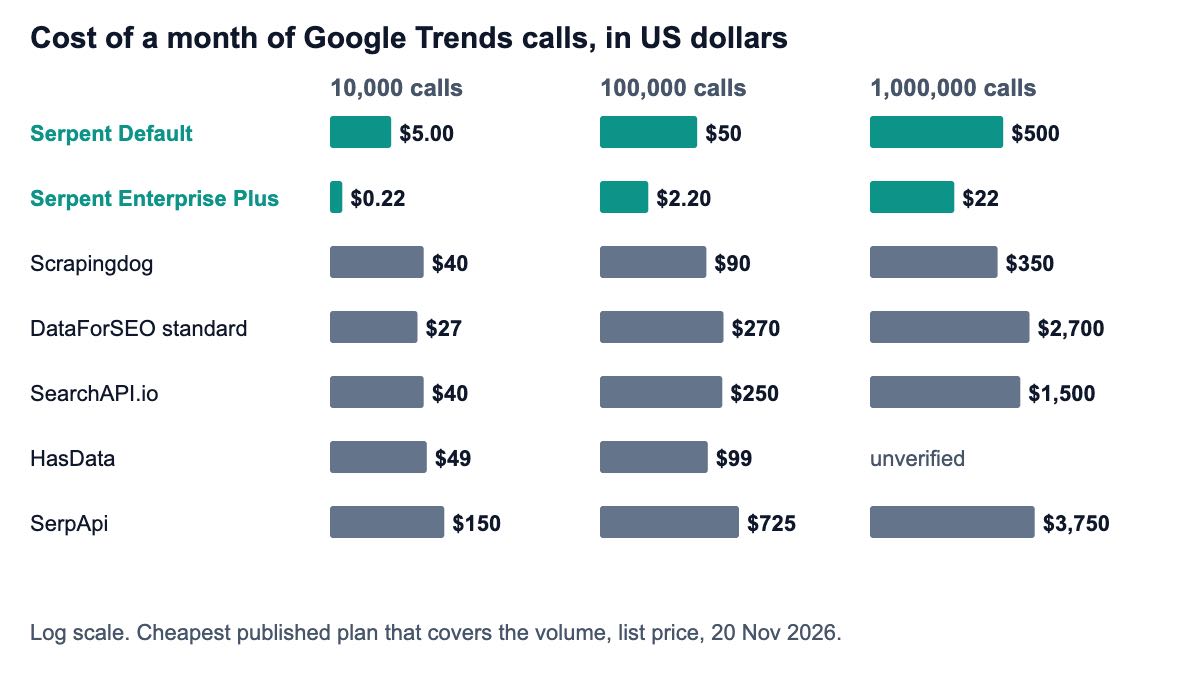
What does a Trends request cost at 10,000, 100,000 and 1,000,000 a month?
At 100,000 requests a month, Serpent costs between $2.20 and $50 depending on tier, while the API providers I could price cost $90 to $725. At a million, Serpent runs $22 to $500 against $350 to $3,750 at the providers that publish a plan that size.
| Provider and plan | 10,000 a month | 100,000 a month | 1,000,000 a month |
|---|---|---|---|
| Serpent API: Default (pay as you go) | $5.00 | $50.00 | $500.00 |
| Serpent API: Growth ($100 deposit) | $2.30 | $23.00 | $230.00 |
| Serpent API: Scale ($500 deposit) | $1.00 | $10.00 | $100.00 |
| Serpent API: Enterprise ($1,000 deposit) | $0.48 | $4.80 | $48.00 |
| Serpent API: Enterprise Plus ($1,250 deposit) | $0.22 | $2.20 | $22.00 |
| Scrapingdog | $40.00 | $90.00 | $350.00 |
| HasData | $49.00 | $99.00 | Unverified |
| SearchAPI.io (assumes 1 search per request) | $40.00 | $250.00 | $1,500.00 |
| DataForSEO, standard queue | $27.00 | $270.00 | $2,700.00 |
| DataForSEO, live | $110.00 | $1,100.00 | $11,000.00 |
| SerpApi (assumes 1 search per request) | $150.00 | $725.00 | $3,750.00 |
| Trends MCP | $199.00 | Unverified | Unverified |
The rule behind each cell is the cheapest published plan or per-use rate that covers the volume, at list price, before tax, with no free credit subtracted. Here is how each row was built, so you can audit it:
- Serpent API. One request is one charge, however many terms (up to five) it compares, so the cost is the rate times the volume. The size of a deposit sets the rate on that credit, and deposited credit does not expire. The first deposit can be as little as $10, and new accounts get 10 free API calls. The five rates are $0.50, $0.23, $0.10, $0.048 and $0.022 per 1,000.
- Scrapingdog. Its pricing page says each Google Trends request costs 5 credits. Lite is $40 for 200,000 credits (40,000 requests), Standard is $90 for 1,000,000 credits (200,000 requests) and Premium is $350 for 6,000,000 credits (1,200,000 requests). A million requests needs 5,000,000 credits, which fits Premium.
- HasData. Ten credits per request, charged only on success, per its Trends documentation. Startup is $49 for 200,000 credits (20,000 requests) and Basic is $99 for 1,000,000 credits (100,000 requests). A million requests needs 10,000,000 credits, and the published plans jump from 3,000,000 credits to “past 20M”, so I left that cell unverified.
- SearchAPI.io. Plans are priced per successful search: Developer is $40 for 10,000 and BigData is $250 for 100,000. A million fits Octo 1M at $1,500. The page lists a Google Trends API but does not give Trends its own price, so the cells assume one search per request.
- DataForSEO. Its Trends pricing page lists $0.0027 per task on the standard queue and $0.011 per task live, and a task can hold up to 5 keywords. I counted one request as one task. The page does not publish a volume discount.
- SerpApi. Its pricing page lists searches per plan but never mentions Trends, so the cells assume a Trends call counts as one search. Production is $150 for 15,000, Searcher is $725 for 100,000 and Cloud 1M is $3,750 for 1,000,000.
- Trends MCP. Its own comparison page (prices labelled June 2026) lists Starter at $19 for 1,000 requests, Pro at $49 for 5,000 and Business at $199 for 25,000. Ten thousand requests needs Business; it publishes nothing bigger.
Here is what the table does not say. At 10,000 requests a month, a $1,250 Enterprise Plus deposit would take far longer than any plan horizon to spend, so the honest Serpent number at that volume is the pay-as-you-go row. The deposit tiers earn their keep when you spend the deposit within a reasonable time. The pricing page shows how deposit size sets the rate.
Why is one request not always one charge?
Because credits, tasks and results are not requests. General scraping APIs meter everything in credits and charge several for a Trends request, so the headline credit price understates the real cost by a factor of 5 or 10.
Scrapingdog says 5 credits and HasData says 10. SocialCrawl charges 5 credits per Explore call and prices in pounds: its own page works that out to about £30 per 1,000 calls on the £15 pack, in a comparison it says was verified in July 2026. I have not converted that to dollars.
DataForSEO sells by the task, and a task can carry up to five keywords, so a five-term comparison costs the same as a one-term lookup there. Serpent works the same way: one request, up to five terms. Two other vendors are quieter. SerpApi and SearchAPI.io do not publish a Trends-specific credit cost, which is why their rows say “assumes one search per request”. If either charges more for Trends, the real number is higher than mine.
Two vendors I left out of the tables. Bright Data's SERP pricing page lists $1.50 per 1,000 requests but does not mention Trends, so I could not tie that price to a Trends request. Oxylabs lists a Google Trends explore source on its product page and shows general Web API prices from $0.50 per 1,000 results, but it gives the Trends source no price of its own, so I could not tie a number to a Trends request.
| Provider | What counts as one unit | Smallest plan, per 1,000 | Largest published plan, per 1,000 | Free tier |
|---|---|---|---|---|
| Serpent API | 1 request, up to 5 terms | $0.50 (Default, pay as you go) | $0.022 (Enterprise Plus) | 10 free API calls |
| Scrapingdog | 5 credits | $1.00 (Lite, $40) | $0.136 (Nova Pro, $30,000) | 100 credits, which is 20 requests |
| HasData | 10 credits | $2.45 (Startup, $49) | $0.693 (Growth, $208) | 1,000 credits, which is 100 requests |
| SearchAPI.io (assumes 1 search) | Not stated for Trends | $4.00 (Developer, $40, 10,000 searches) | $1.00 (Octo 5M, $5,000, 5,000,000 searches) | 100 requests |
| DataForSEO | 1 task, up to 5 keywords | $2.70 (standard queue); $11.00 live | No volume plan published | Not stated on the Trends page |
| SerpApi (assumes 1 search) | Not stated for Trends | $25.00 (Starter, $25, 1,000 searches) | $1.96 (Cloud 54M, $106,050) | 250 searches a month |
| Trends MCP | 1 request | $19.00 (Starter, 1,000 requests) | $7.96 (Business, $199, 25,000 requests) | 100 requests a month |
| SocialCrawl | 5 credits per Explore call | About £30 (its own estimate, £15 pack) | Not captured | Not captured |
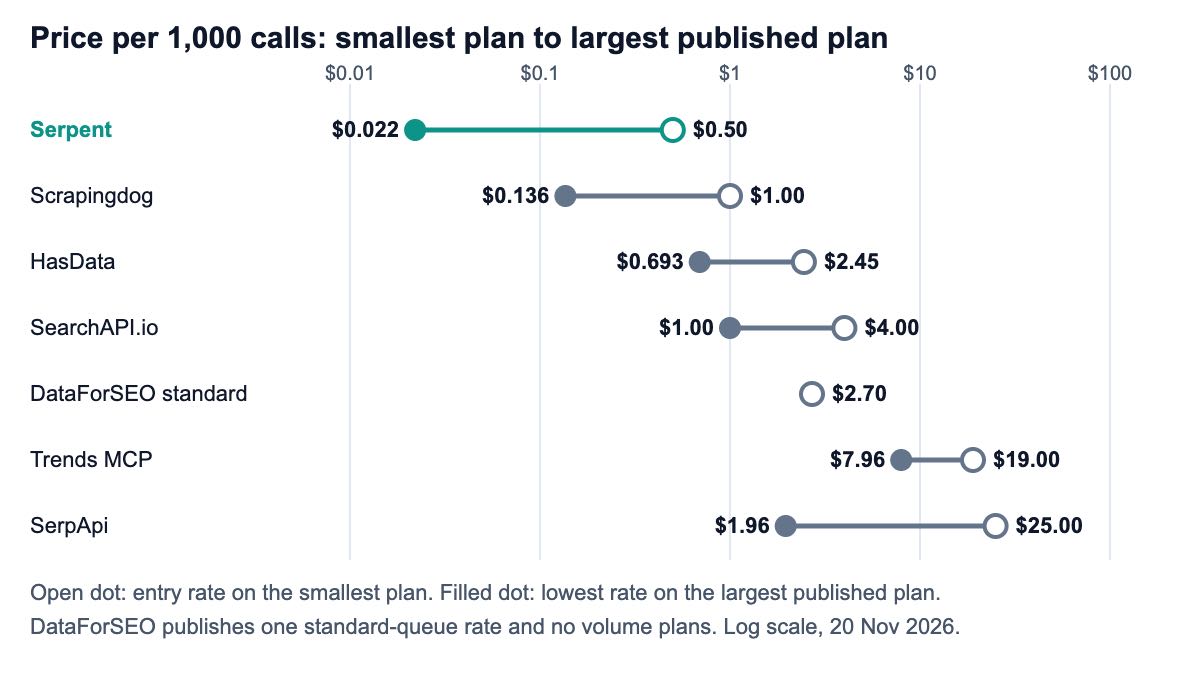
Look at the length of each line in the chart. Scrapingdog's price falls from $1.00 to $0.136 per 1,000, and SerpApi's from $25.00 to $1.96, but you only reach the low end by committing to a plan far bigger than a small project needs. Scrapingdog's $0.136 is the Nova Pro plan at $30,000 a month for 220 million requests, which is a buyer very few of us are. The realistic comparison for most teams is the left-hand, open dot.
Serpent's line is the shortest in absolute terms and the lowest on the page at both ends, but I would not decide on that alone. Read the next two sections before you do.
What is the catch with the cheap Apify actors?
The lowest numbers anywhere near this topic come from Apify, a marketplace where independent developers publish scrapers as “actors”. Each actor sets its own price, units and limits, and many bill a start fee per run, so read the actor page before you build on one.
| Actor | Billed unit | Price per 1,000 units | Users, last 30 days |
|---|---|---|---|
| apify/google-trends-scraper | Result item, plus a $0.00005 start fee | $6.00 (free tier) to $1.50 (Diamond) | 3,608 |
| data_xplorer/google-trends-fast-scraper | Result, plus a $0.025 start fee per run | $2.00 to $0.50 | 707 |
| agenscrape/google-trends-scraper | Result, plus a $0.025 start fee per run | $25.00 flat | 246 |
| scrapesage/google-trends-scraper | Keyword analysis | $4.00 | 228 |
| khadinakbar/google-trends-scraper | Result item | $5.00 | 190 |
| unitbytes/google-trends-scraper | Result scraped | $0.45 to $0.30 | 64 |
| automationnation/google-trends-scraper | Keyword report (one term, one region, one range) | $1.00 to $0.27 | 8 |
| cozybit/google-trends-scraper | Explore report (one keyword) | $2.00 after a trial rate of $0.01 that ends on 31 Dec 2026 | 1 |
Three things stand out.
First, the unit. Most actors bill a “result” and the store listing does not say whether that is one report per term or one row per date. A 12-month weekly timeline has 53 rows, so an actor that billed per row would cost 53 times its headline for one series. Only a few actors spell it out: automationnation says one report per term, and cozybit says one report per keyword.
Second, the cheapest rows belong to the smallest sellers. The two lowest standing prices in the table come from actors with 8 and 64 users in the last 30 days, and the lowest of all is a trial that ends on 31 December 2026 and then rises to $2.00. The most-used actor, apify/google-trends-scraper with 3,608 users, charges between $1.50 and $6.00 per 1,000 result items depending on the Apify plan tier.
Third, the bill is more than the price. Some actors state that the buyer pays Apify platform usage on top, and I did not research Apify's own account fees, so a real Apify bill may sit above the numbers here. A marketplace actor is fine for a one-off research run. For a service that must answer a user's request in a few seconds, you want an API that takes one request per report.
What do you get for the money?
With Serpent, one GET request to /api/trends/interest returns Google Trends interest over time: the geography, the time range and the search type you asked for, each term with its average, and a timeline with one row per point in time. Each row carries a Unix timestamp, a readable date, one value per term (0 to 100, or null when there is no data) and an is_partial flag for the period still in progress. The Google Trends API page lists every field and the docs explain each parameter.
You send q with 1 to 5 comma-separated terms, optionally geo such as US, GB or US-TX (worldwide by default), time from now 1-H to all or a custom pair of dates, category, and property set to web, images, news, youtube or shopping. The default range is today 12-m.
On a fixed set of 61 queries chosen before any call was made, 59 returned a full timeline, 1 correctly came back with no data and 1 failed and was not charged. The median call took about 5.4 seconds. On the three pages we compared side by side with Google's own Trends page in a browser, every date and every value matched. The set covered 10 countries, 7 languages, web, news, shopping and YouTube searches, ranges from 4 hours to all time, and a five-term comparison.
Other vendors do more, and if you need these features you should price those vendors instead of the cheapest row:
- SerpApi's Trends API offers interest over time, a compared breakdown by region, interest by region, related topics and related queries as separate data types.
- HasData's documentation lists timeseries, geoMap, relatedTopics and relatedQueries.
- Scrapingdog's Trends page lists interest over time, interest by region and a compared breakdown by region.
- Several Apify actors sell Trending Now rows, including data_xplorer's dedicated trending-now actor.
If your project mostly needs the line on the chart for one to five terms, the extras are cost you do not need to pay. For the code-level view see how to get Google Trends data with Python and Node, and for a worked use case see Google Trends Data for SEO Content Planning.
What about Google's own Trends API and the free libraries?
Google announced an official Trends API alpha on 24 July 2025. It is limited to a small number of testers, covers a rolling window of 1,800 days (about five years) and scales values consistently across requests, which the website does not. The announcement gives no price. If you can get in, it is the first thing to try. If you cannot, it does not help a project that ships this quarter.
The free route is a library such as pytrends. Its GitHub repository was archived by its owner on 17 April 2025 and is read-only, and the last release on PyPI is 4.9.2 from 13 April 2023. Free libraries cost nothing in fees, but they leave rate limits and Google's changes to you. The Python and Node guide walks through what that means in code.
Which free tiers are worth using?
For a prototype, any of them. Serpent gives a new account 10 free API calls. Scrapingdog gives 100 credits, which is only 20 Trends requests at 5 credits each. HasData gives 1,000 credits a month, which is 100 requests at 10 each. SerpApi gives 250 searches a month, SearchAPI.io gives 100 requests, and Trends MCP's free plan is 100 requests a month. Apify's actors draw on its free plan's monthly credit, and I did not research its size.
Free tiers reward careful reading. Two vendors that look generous on credits shrink once you divide by the credits a Trends request uses. Count requests, not credits, before you decide which prototype fits in the free allowance.
If you are choosing for a wider SEO stack, the same key also covers web search results. See the SERP APIs, the Rank Tracking API and the News API. For per-1,000 prices in web search, the SERP API pricing comparison applies the same method.
Which one should you pick?
Here are named picks by scenario, on the evidence I have:
- Prototype or a few thousand requests a month: Serpent's pay-as-you-go rate. Ten thousand requests is $5.00, and you start with 10 free API calls.
- A steady 100,000 requests a month: Serpent. The pay-as-you-go row is $50 and the highest tier is $2.20, against $90 at Scrapingdog's Standard plan and $270 at DataForSEO's standard queue.
- A million a month or more: Serpent Enterprise Plus at $22 per million. Scrapingdog's biggest plan is cheaper per request on paper, but it is a $30,000-a-month plan built for hundreds of millions.
- Related queries, regional maps or Trending Now in the same call: SerpApi, HasData or Scrapingdog, which list those data types.
- A one-off research pull where you can live with the unit puzzle: an Apify actor, after reading its page.
- You can get into Google's alpha: use it, since it scales values consistently across requests.
- You already pay a scraping API for other work: use its Trends endpoint to keep one bill, but multiply the credit price by its credits per request first.
The one situation where I would not choose on price is a product whose users wait on the result. Check hit rate and speed on your own list of queries before you commit, which is easy because the playground lets you try real terms. The best SERP API comparison and the notes on DataForSEO pricing cover the neighbouring decisions.
How we checked this
What I checked. On 20 November 2026 I opened each vendor's own pricing page or documentation and the Apify store's public listing, and collected 15 price rows: seven API providers and eight Apify actors. Each row records the unit, the entry price, the largest published plan and any free tier. The monthly costs are my own arithmetic from those prices, shown above so you can repeat it.
Serpent's own numbers. The five Serpent rates are the published rates. The 61-query check is a fixed list drawn before any call was made. Of the 61, 59 returned a full timeline, 1 correctly came back with no data and 1 failed and was not charged, with a median call of about 5.4 seconds. In a browser, five query pages were opened on Google's own Trends page and three finished loading their chart: black friday in the US over three months (93 points), ipl on YouTube in India over twelve months (53 points) and chatgpt in the UK over seven days (169 points). All three matched point for point, with every date and value the same.
This is Serpent's check of Serpent's product, so treat it as a vendor claim and try your own list.
What I could not verify:
- Bright Data is excluded because its SERP pricing page does not mention Trends, and Oxylabs because its page gives the Trends source no price of its own, only general Web API rates.
- SerpApi and SearchAPI.io do not state a credit cost for Trends, so their rows assume one search per request. SerpApi's own pricing page does not mention Trends.
- Trends MCP and SocialCrawl prices come from their own pages, which carry June 2026 and July 2026 stamps rather than 20 November. SocialCrawl prices in pounds and is not converted.
- Apify's billed unit is not stated for most actors, user counts drift by a few users from day to day, and Apify's own account fees were not researched.
- Google's alpha API has no published price.
Prices change often, so re-check any vendor within a week of buying.
Price your own volume
Serpent's Google Trends API is from $0.022 per 1,000 requests — pay as you go, no subscription, with 10 free API calls to start. Try a real term in the playground before you write any code.
Get Your Free API KeyExplore: Google Trends API · Playground · Docs · Pricing
FAQ
What is the cheapest Google Trends API?
On public prices checked on 20 November 2026, Serpent API has the lowest standing price of any Google Trends API I could find: $0.022 per 1,000 requests on its highest tier, about six times below the next lowest published rate ($0.136 at Scrapingdog), and $0.50 pay as you go, half Scrapingdog’s $1.00, the lowest entry price I could verify at monthly list prices. Among API providers I could price on 20 November 2026, entry prices start at $1.00 per 1,000 requests at Scrapingdog and rise to $25.00 at SerpApi.
How much does it cost to get 1,000 Google Trends results?
At API providers it ranges from $1.00 to $25.00 per 1,000 requests on a smallest plan, and from $0.136 to $7.96 on their largest published plans. Credit-based vendors multiply the raw price by 5 or 10, so convert to a per-request price before you compare. Apify actors bill per result item, which is not always a whole report.
Is there a free Google Trends API?
Several services have free tiers: 10 free API calls at Serpent, 100 credits at Scrapingdog, 1,000 credits a month at HasData and 250 searches a month at SerpApi. Free tiers are meant for testing. Google's own Trends API is an invite-only alpha with no published price, and the pytrends library is free but archived and read-only since April 2025.
Why do some Trends APIs charge 5 or 10 credits per request?
They are general scraping APIs that meter every call in credits, and a Trends request is one of many products on the same meter. Scrapingdog's pricing page says 5 credits per Google Trends request and HasData's documentation says 10, so a plan's credit count is five or ten times its request count. Trend-specific services usually charge one credit or one request per call.
Are Google Trends API results search volumes?
No. Google Trends scales every data point to a 0 to 100 index, dividing each point by the highest point, so a value shows relative interest, not a count of searches. Compare terms in one call, because each call is scaled on its own. If you need absolute volumes, pair Trends with another source.
How often do Google Trends API prices change?
Often enough to matter. A trial price on one Apify actor ends on 31 December 2026 and rises from $0.01 to $2.00 per 1,000 reports, and the most-used actor's current price took effect on 6 November 2026. Treat any price in a comparison, including this one, as a snapshot, and open the vendor's pricing page within a week of buying.
Sources
API provider pricing and documentation (checked 20 Nov 2026):
- Scrapingdog pricing
- Scrapingdog Google Trends API
- HasData pricing
- HasData Google Trends documentation
- SearchAPI.io pricing
- DataForSEO Google Trends pricing
- SerpApi pricing
- SerpApi Google Trends API
- Bright Data SERP pricing: no Trends mention
- Oxylabs Google Trends source: no Trends-specific price
Comparison pages from other vendors (dates as stamped on each page):
- Trends MCP pricing comparison: prices labelled June 2026
- SocialCrawl: best Google Trends APIs: verified July 2026 per the page
Apify store listings (checked 20 Nov 2026):
- Apify store public listing, Google Trends search
- apify/google-trends-scraper
- automationnation/google-trends-scraper
- cozybit/google-trends-scraper
Google and open-source projects (checked 20 Nov 2026):